
 Evidence
 Based on existing evidence, the following elements are key to whether programmes are effective in reducing VAW or risk factors for VAW.
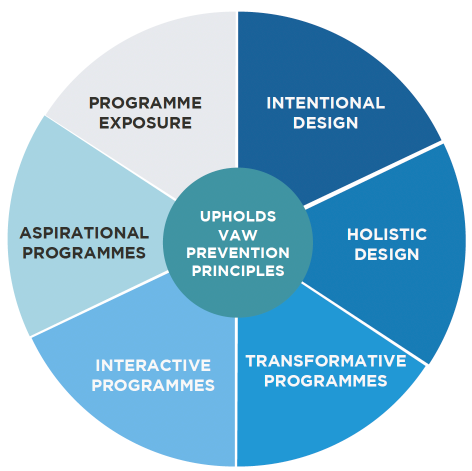
PROGRAMME “EXPOSURE” comprises sufficient ‘reach’ [the number and proportion of people exposed to the programme activities in a location] AND adequate ‘intensity’ [of those programme activities with those people]. | “INTENTIONAL” DESIGN comprises a clear vision for specific change(s) AND a plan for how to achieve the change [Based on established theory, research- based evidence and/or practice-based learning]. |
“ASPIRATIONAL” PROGRAMMES inspire and support participants to make positive changes by focusing on a positive vision of a violence-free future. They highlight the benefits of non-violent behaviours and healthy relationships for women, men, families and communities. | “HOLISTIC” DESIGN = design programmes which use multiple strategies and activities to address different drivers of violence against women. |
“INTERACTIVE” PROGRAMMES create opportunities for participants to engage actively in reflection, discussions and practical activities in collaboration with others. | “TRANSFORMATIVE” PROGRAMMES create opportunities for individuals and groups to critically reflect on the attitudes, behaviours and norms which sustain gender-power imbalances and VAW, and to develop motivation and skills to address these. |
 Related resources