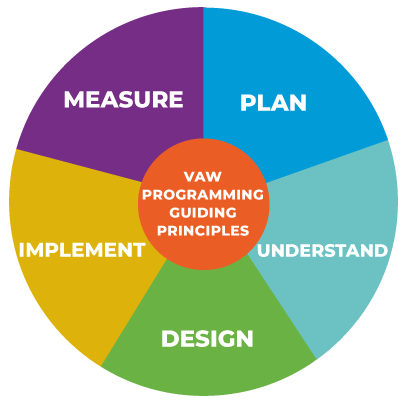

This guide is a practical and accessible resource designed to support programme managers and specialists in navigating the key steps of planning, designing, implementing, and evaluating initiatives to prevent violence against women (VAW). It is grounded in real-world contexts, reflecting the opportunities and constraints faced by practitioners working to prevent and end violence against women within complex systems of partnerships, political dynamics, donor expectations, heavy workloads, and feminist principles.
How was this guide developed?
This guide was conceptualized by UN Women’s Regional Office for Asia and the Pacific (ROAP), following years of technical support to countries and partners in the region which pointed to common challenges in designing, implementing, and measuring changes in prevention programmes. It draws on the practical experience and insights of specialists focused on ending violence against women and their insights. The guide aims to bolster prevention programming and includes a review of the latest evidence, and a range of existing UN and external guidance materials. The guide was developed in cooperation with the Prevention Collaborative, and the guide has been edited and revised by UN Women ROAP.
This guide was originally developed as an internal resource for UN Women personnel and programmes. However, over time the content has been drawn into learning material on prevention with partners, which helped to further shape and refine the guide. It is now available for a public audience.
Forty practitioners, programme managers, and technical experts from multiple regions reviewed and contributed feedback to strengthen and refine the guide. UN Women appreciates the contributions of all who have provided feedback and inputs to shape this resource.
Suggested citation: UN Women. (2024). Violence against Women Prevention Programming Guide. UN Women; Prevention Collaborative; Australian Department of Foreign Affairs and Trade. https://vawpreventionguide.online/
Structure of this Guide
The Guide is broadly structured in order of key steps of planning, understanding context, designing, implementing, and measuring a prevention programme and has six main sections:
- Follow guiding principles for VAW programming
- Plan for a prevention programme
- Understand your context for prevention
- Design for success
- Ensure high-quality implementation
- Measure change and learn
Although the Guide is not intended to be read in a linear fashion, these steps are all important to support EVAW staff to make well-informed and feasible decisions about VAW prevention programming based on their context, available evidence, and their organisational position.