 Decision-making guides
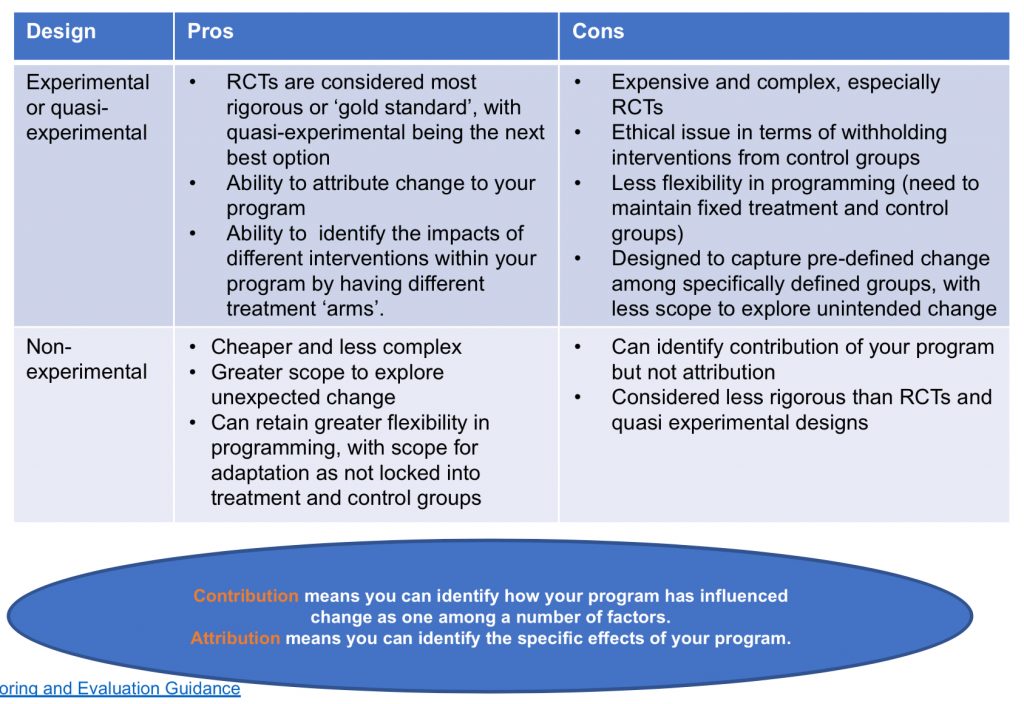
 In order to produce robust evidence of your program’s impact on VAW prevalence or known risk factors for VAW (e.g. gender inequitable attitudes, alcohol abuse, couple conflict) you will need to use one of three types of evaluation design: experimental, quasi experimental or non-experimental.
EVALUATION DESIGNS
Experimental design: These are Randomised Control Trials (RCTs) which essentially ‘test’ the difference between groups which experience your program’s interventions (‘treatment’) and those which do not (‘control’). Crucially, treatment and control groups are randomly assigned.
Quasi-experimental design: These are similar to RCTs but with the difference that treatment and control groups are matched rather than being randomly assigned.
Non-experimental design: These do not include treatment and control groups. Instead they usually include a more basic before and after comparisons.