

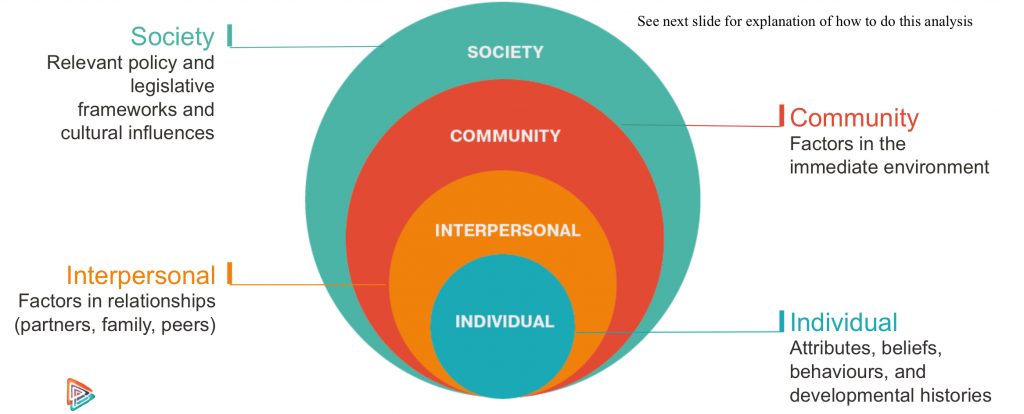
The Socio-ecological model is a useful tool to explore the interaction between multiple factors operating across and within the different levels, which increase or decrease the likelihood of violence. The model suggests that in order to prevent violence, it is necessary to act to address multiple factors across these levels. This approach is more likely to result in effective and sustained prevention over time than any single intervention.
At the heart of the socio-ecological model is an individual. The different circles demonstrate that an individual’s health, wellbeing, and even behaviour are affected by factors operating at an individual, interpersonal, community, and societal level.
Your team can use this model to draw on the data collected in your contextual analysis about the drivers of a specific form of violence in your context and map the risk factors across these levels. It can be done in person in a participatory workshop using flipcharts and sticky notes.
Key considerations when doing this analysis:
- Types of violence: Different forms of violence may have different risk factors
- Life course perspective: Different risk factors are more relevant at different ages and stages of development
- Specific setting: Specific risk factors are more or less important in different settings
- Victimisation vs perpetration: Different risk factors may be important for victimisation vs. perpetration
Examples of risk factors for intimate partner violence:
INDIVIDUAL LEVEL
- Individual women – gender inequitable attitudes
Evidence shows that a woman is at great risk of experiencing violence from her husband if she believes that it is acceptable for her husband to perpetrate violence against her is one of more circumstances.
- Individual man – harmful alcohol use
Evidence shows that a man might is more likely to perpetrate violence against his wife if he frequently engages in harmful alcohol use.
INTERPERSONAL LEVEL
- Household poverty
Evidence shows that there is a greater risk of intimate partner violence occurring if a household is under economic stress.
- Poor communication skills
Evidence shows that there is a greater risk of intimate partner violence occurring if a couple has poor communication skills.
COMMUNITY LEVEL
- Norm of male authority
Evidence shows rates of IPV are higher in contexts where there is a widely shared expectation (norm) that men should exercise authority over women and women should be submissive.
- Norms that tolerate IPV
Evidence shows rates of IPV are higher in contexts where there is a widely shared expectation (norm) that it is acceptable for a man to beat his wife when she disobeys him.
SOCIETAL LEVEL
- Gender inequitable legislation
Evidence shows that there are usually higher rates of IPV in contexts where there is legislation which prevents women from inheriting land and property in the case of divorce.